Have you been feeling more tired than usual, dealing with mood swings, irregular periods, stubborn weight gain, or constant stress? These could all be signs that your hormones are out of balance. While medical treatment may be necessary for certain hormonal conditions, simple lifestyle changes can also make a meaningful difference. One of the most effective and natural approaches is practicing yoga for hormonal balance. By combining mindful movement, deep breathing, and relaxation, yoga helps reduce stress and supports the body’s endocrine system—the network of glands responsible for producing and regulating hormones. In this article, In this blig, our yoga experts in Surat available at The Naari, will share five yoga poses that actually work, explain how they support hormonal health, and offer practical tips to help you make them part of your daily routine.
Most women are told to rest more. Stress less. Eat better. And while none of that advice is wrong, it rarely addresses what is actually happening beneath the surface.
Hormones are the body’s most intricate messaging system. When they are in conversation with one another, when oestrogen, progesterone, cortisol, insulin, and thyroid hormones are each doing their part, a woman feels it. She feels well in a way that is hard to articulate but impossible to miss. And when that conversation becomes disrupted, she feels that too.
Yoga for hormonal balance in Surat is not a wellness trend. It is one of the oldest, evidence-supported tools available to women navigating the complexity of their own endocrine system. Practised consistently, with intention, it can reduce cortisol, support thyroid function, improve insulin sensitivity, and restore a quality of ease to the body that no supplement alone can replicate.
These are the five poses that, in our experience at The Naari, make the most meaningful difference.
Why Yoga Works for Hormonal Imbalance
Yoga for hormonal imbalance works through several overlapping mechanisms. It activates the parasympathetic nervous system, the body’s rest-and-restore mode, which directly reduces the cortisol that disrupts every other hormonal conversation when left chronically elevated. Specific poses stimulate blood flow to the endocrine glands: the thyroid, the adrenals, and the ovaries. Others decompress the nervous system at the level of the spine, where so much tension quietly accumulates.
This is why structured yoga meditation classes available in Surat with us at The Naari, can be especially helpful when it is designed around a woman’s life stage, symptoms, cycle patterns, and overall health rather than offered as a general fitness routine.
5 Yoga Poses for Hormonal Balance
Supported Bridge Pose (Setu Bandhasana)
The bridge pose opens the chest and throat, where the thyroid gland sits, while gently stimulating the reproductive organs through increased pelvic blood flow. In its supported variation, with a block or bolster beneath the sacrum, it becomes deeply restorative: the nervous system settles, the adrenals decompress, and the body is permitted to stop bracing against itself.
How to practise it: Lie on your back with your knees bent and feet flat on the floor, hip-width apart. Press into your feet and lift your hips. Place a block or folded blanket beneath your sacrum and allow your weight to release fully into the support. Stay here for three to five minutes. Breathe slowly.
Particularly beneficial for: Thyroid imbalance, adrenal fatigue, chronic stress, irregular cycles
Reclining Bound Angle Pose (Supta Baddha Konasana)
This is the pose of complete surrender, and that, for many women, is precisely the challenge.
Reclining bound angle opens the inner groin and pelvis, stimulating the ovaries and uterus while releasing the hip flexors, where the body tends to store stress with extraordinary loyalty. As a restorative pose, it is most powerful when held for five minutes or longer, supported by bolsters or cushions beneath the knees.
The endocrine benefit is genuine. Research into yoga for PCOS consistently identifies restorative hip-opening practices as supportive of ovarian function and cortisol regulation, two factors that sit at the centre of polycystic ovarian syndrome.
How to practise it: Lie on your back. Bring the soles of your feet together and allow your knees to fall outward. Place cushions beneath each knee for support. Rest your hands on your belly or beside your body. Close your eyes. Stay for five minutes, breathing into the pelvis with every exhale.
Particularly beneficial for: PCOS, menstrual irregularity, pelvic tension, anxiety
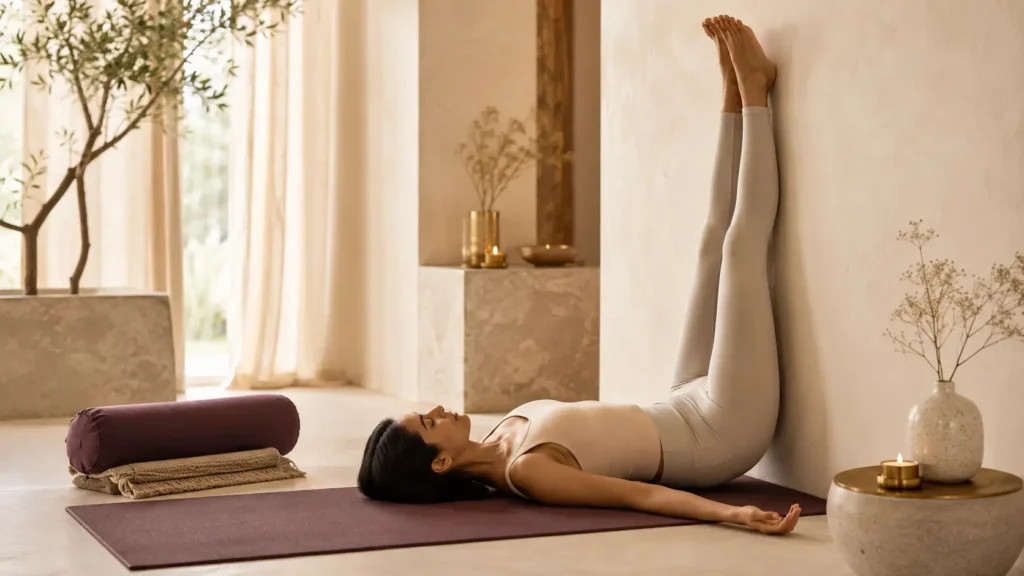
Legs Up the Wall (Viparita Karani)
This mild inversion reverses the gravitational pull on the body, encouraging venous blood to return from the legs to the heart and pelvis. It regulates the adrenal glands, calms the nervous system, and, for women who practise it in the days before menstruation, can meaningfully reduce the premenstrual hormonal surges that make the second half of the cycle feel unmanageable.
How to practise it: Sit sideways beside a wall. Swing your legs up as you lower your back to the floor. Your sitting bones need not touch the wall. Rest your arms by your sides, palms facing upward. Remain here for five to fifteen minutes. Do nothing. That is the practice.
Particularly beneficial for: PMS, oestrogen dominance, adrenal dysregulation, insomnia
Seated Forward Fold (Paschimottanasana)
Among the yoga poses for hormonal balance, this one tends to be the most underestimated.
A deep forward fold compresses and then releases the abdominal organs, including the adrenal glands, which sit atop the kidneys, and the digestive organs that play a more significant role in hormonal metabolism than most women realise. The liver, in particular, is responsible for processing and clearing excess oestrogen from the body. Practices that improve circulation to this region support that process.
How to practise it: Sit with your legs extended. Inhale to lengthen the spine. On the exhale, fold forward, not with force, but with ease. Allow gravity to do the work. Hold your shins, ankles, or feet, wherever your hands arrive without strain. Stay for two to three minutes, breathing deeply into the back body.
Particularly beneficial for: Oestrogen dominance, digestive sluggishness, liver congestion, cortisol dysregulation
Corpse Pose (Savasana)
Savasana is not a rest between poses. It is the pose. It is where the nervous system consolidates the physiological shifts that the preceding practice has initiated. Cortisol falls. The parasympathetic system deepens its hold. The body integrates.
Five minutes of genuine Savasana, eyes closed, body still, breath natural, does more for the hormonal system than any rushed vinyasa sequence practised while mentally composing tomorrow’s to-do list.
How to practise it: Lie flat on your back. Let your feet fall outward. Rest your arms a little away from your body, palms facing upward. Close your eyes. Do not move. Stay for a minimum of five minutes, ten if you can.
Particularly beneficial for: All hormonal concerns, cortisol regulation, nervous system recovery, sleep quality
A single session of yoga will offer relief. A consistent practice, three to four times per week, held across months, is where genuine hormonal change becomes possible.
For those navigating the challenges of hormonal imbalance, whether that is PCOS, perimenopause, thyroid disruption, or the chronic cortisol load of a life that never quite pauses, yoga therapy in Surat is available at The Naari as part of our integrated women’s wellness offering.
FAQ
How quickly can yoga support hormonal balance?
Some women feel better sleep, mood, and energy within 2–3 weeks. Bigger hormonal changes usually take 2–3 months of consistent practice.
Is yoga safe during PCOS or irregular periods?
Yes, with the right modifications. Gentle and restorative yoga is usually safe, while intense poses may need to be adjusted.
Can yoga replace medical treatment?
No. Yoga supports medical care, but it does not replace diagnosis or treatment for PCOS, thyroid concerns, or perimenopause.
Which yoga poses should be avoided?
Fast-paced hot yoga, intense inversions, and vigorous sequences may not suit women with hormonal imbalances. Slow, breath-led practice is a better starting point.
Does The Naari offer yoga programmes?
Yes. The Naari offers yoga as part of its women’s wellness approach, guided by specialists in a private, supportive space.